中文简体
中文简体 Search
 Contact

Consultation/Cooperation
010-68711086HR Line
010-62137913-8605 Publish Date:
 Visits:
On the afternoon of March 26, 2024, the Fullgoal Institute for ESG Research of Shanghai University of Finance and Economics (SUFE) held its annual key project thesis proposal defense meeting and ESG lecture series with the theme "ESG Impact Valuation".
Mr. Yin Gefei, Chief Expert of GoldenBee Consulting and Chairman & CEO of Yibiao Digital Technology Co., Ltd. (OneESG), was invited to this event.
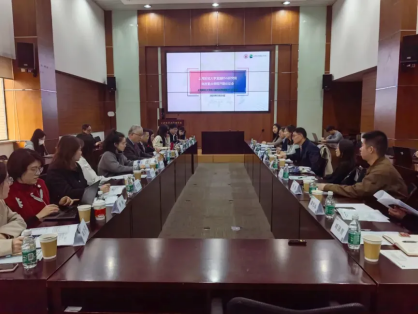
As the annual key project of the Institute in 2024, "ESG Impact Evaluation" is led by Mr. Sun Junxiu, assistant dean and researcher of the Institute,
and associate professor at the School of Public Economics and
Administration of SUFE. During the thesis proposal defense meeting in
the afternoon, Mr. Yin Gefei provided targeted recommendations for the project implementation
from the practical perspective, combining the development and practical
experience of the OneESG platform of Yibiao Digital Technology Co.,
Ltd.
After that, Mr. Yin Gefei delivered a lecture titled "ESG Value Accounting and Construction of Sustainability Micro Mechanisms" to the attending guests.
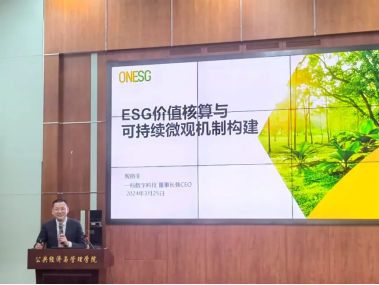
During the opening stage of the lecture, Mr. Yin
Gefei provided an overview of the background and development history of
the gradual exploration of "measuring the environmental and social
externalities of companies with a monetary indicator" since 2012. This gave audience a clue of the significance and practical value of ESG value accounting.
In
the section on ESG value accounting, he introduced two important
indicators: (1) ESG net value, which measures the comprehensive
monetized value of a company's externalized costs and values related to
the environment and society; and (2) ESG risk-opportunity value, which
measures the monetized value of a company's ESG net value level compared
to the industry benchmark level. Through such a method, it's found that over 50% of the A-share listed companies have ESG investment value, as revealed by the ESG value accounting from 2017 to 2022.
Then Mr. Yin Gefei shared his thoughts on how ESG value accounting assists in building sustainability micro mechanisms, including sustainability disclosure mechanisms, policy mechanisms, valuation mechanisms, investment mechanisms, and consumption mechanisms.
(1) Construction of sustainability disclosure mechanisms: Based on the Guidelines for Self-Regulation of Listed Companies—Sustainability Report (Exposure Draft) issued by the Shanghai, Shenzhen, and Beijing Stock Exchanges, some listed companies are taking on ESG value accounting to develop new "ESG Reports" that showcase the performance of corporate sustainable development, building upon the three major financial statements.
(2) Construction of sustainability policy mechanisms: With the increasing coverage across companies, ESG value accounting data will form a benchmark reference for sustainability policy formulation. By increasing financial
benefits to companies with ESG values higher than the benchmark level
and imposing financial costs on companies with ESG values lower than the
benchmark level, it will support government agencies in formulating sustainability policies.
(3) Construction of sustainability valuation mechanisms: ESG value accounting data can be better integrated with financial data and incorporated into existing corporate valuation models to construct comprehensive valuation models that include both business and sustainability performance.
(4) Construction of sustainability investment mechanisms: ESG value accounting data can intuitively reflect a company's externalities on the environment and society. It can be organically combined with ESG rating data to identify and mitigate potential "green wash" risks faced by investment institutions.
(5) Construction of sustainability consumption mechanisms: ESG value accounting data provides consumers with intuitive numerical references, enabling them to support companies with higher ESG values and ESG risk-opportunity value through purchasing behavior. This contributes to the formation of a more systematic sustainability consumption mechanism.